
Ranking Facebook Posts in Google Made Simple | James Dooley & Jesper Nissen
Listen on your favourite platform
| Platform | Link |
|---|---|
| YouTube | Listen on YouTube → |
What Does “Ranking Facebook Posts in Google Made Simple | James Dooley & Jesper Nissen” Talk About?
This episode of the Online Reputation Management Podcast features James Dooley and Jesper Nissen breaking down a practical method for ranking Facebook posts in Google Search. The conversation begins with Jesper explaining that Meta changed its indexing rules last summer, allowing posts from Facebook, Instagram, and Threads to appear in Google results. Crucially, personal profile posts are excluded from this, meaning only company pages and public group posts are eligible to rank. The episode covers the specific mechanics of how Google determines the SEO title for Facebook posts, which Jesper explains is derived from the first 7 to 12 words of the post, up until the first line break.
The hosts go deeper into practical tactics, including how to retrieve the correct shareable URL from a Facebook post and submit it to an indexing tool for near-instant crawling. Jesper shares his approach to building supporting backlinks using Web 2.0 platforms like Blogger, Tumblr, WordPress.com, and Ghost to give the Facebook post a slight ranking boost. The episode also explores advanced use cases such as embedding Google Maps share links within posts to boost local SEO visibility, using images to target Google image search results, and leveraging post engagement and comments as signals before re-indexing. Jesper also explains why he prefers company pages over Facebook groups, noting that group engagement has dropped to near zero while branded pages continue to attract interaction.
“What Google does is it takes the first 7 to 12 words and uses them as the SEO title. So, how to do link building for a new website. If you start your post with those words, that will be the SEO title that Google shows when you send it to the indexer.”
— Jesper Nissen
Who Are the Guests on “Ranking Facebook Posts in Google Made Simple | James Dooley & Jesper Nissen”?
James Dooley is a well-known SEO expert and host of the Online Reputation Management Podcast. He is recognized in the SEO community for his expertise in parasite SEO, link building, and digital PR strategies. Throughout the episode, James steers the conversation with targeted questions, demonstrating his deep understanding of technical SEO concepts and his hands-on experience with ranking social media assets in Google.
Jesper Nissen is an SEO specialist with a particular focus on ranking social media content within Google Search. He has built a personal brand on Facebook with close to 15,000 followers and runs the website yes.com. Jesper brings detailed, tested insights to the episode, including specific technical behaviors he has observed when indexing Facebook posts, making him the authoritative voice on the practical application of this method.
What Are the Key Takeaways From “Ranking Facebook Posts in Google Made Simple | James Dooley & Jesper Nissen”?
Here are the key points discussed in this episode:
- Meta changed its indexing rules last summer, enabling posts from Facebook company pages and public groups to rank in Google Search, while personal profile posts remain excluded.
- Google uses the first 7 to 12 words of a Facebook post as the SEO title, making it essential to place your exact target keyword at the very start of the post before any line break.
- Submitting the Facebook post URL directly to an indexing tool can result in the post being indexed within minutes to a couple of hours, dramatically speeding up visibility.
- Building supporting backlinks from free Web 2.0 platforms like Blogger, Tumblr, and Ghost to the Facebook post can provide a measurable ranking boost even if those domains are considered low authority.
- Inserting a Google Maps share link into a Facebook post is a practical local SEO tactic that causes the map to render inside the post when viewed from Google Search results, strengthening local entity signals.
“I write the post on Facebook, then I grab the link from Facebook and make another long-form article on these four or five blogging platforms. Then I insert the backlink to the Facebook post. I send all five to the indexers, and what I see is that the Facebook page or post ranks a little bit higher because I do that.”
— Jesper Nissen
Is “Ranking Facebook Posts in Google Made Simple | James Dooley & Jesper Nissen” Worth Listening To?
This episode is worth listening to because it delivers a genuinely actionable, step-by-step framework for a parasite SEO tactic that most practitioners are not fully utilizing. Rather than staying at a surface level, Jesper Nissen shares specific technical details he has personally tested, such as the line break behavior that affects the SEO title cutoff, the exact method for retrieving the correct post URL, and the Web 2.0 stacking approach that provides an additional ranking lift. These are not theoretical ideas but observed behaviors drawn from real campaigns.
What makes this episode particularly valuable is its focus on local SEO applications, including the Google Maps link embed trick that adds a visual map directly inside the Facebook post in search results. The discussion around image search, post engagement as a re-indexing signal, and the preference for company pages over groups rounds out a comprehensive playbook. Whether you are managing reputation for a local business, building out a parasite SEO strategy, or simply looking for faster ways to appear in Google, this episode gives you immediately applicable techniques backed by firsthand testing.
Who Should Listen to “Ranking Facebook Posts in Google Made Simple | James Dooley & Jesper Nissen”?
This episode is ideal for:
- Local SEO professionals looking for fast-ranking tactics to improve visibility for service-area businesses in Google Search
- Reputation managers and brand strategists who want to use social media assets to control what appears in branded search results
- Parasite SEO practitioners and content marketers seeking new platforms and methods for ranking content without owning a high-authority domain
- Small business owners and digital marketers who want to leverage existing Facebook company pages to generate organic search traffic without heavy link building investment
Where Can You Listen to Online Reputation Management Podcast?
You can listen to Online Reputation Management Podcast on all major podcast platforms:
- Apple Podcasts – Search for “Online Reputation Management Podcast” in the Podcasts app
- Spotify – Available on Spotify for free
- Amazon Music / Audible – Listen through your Amazon account
- Overcast – For iOS users who prefer a dedicated podcast app
- Pocket Casts – Cross-platform podcast player
You can also subscribe using the RSS feed: https://feeds.transistor.fm/online-reputation-management-podcast
What Are Listeners Saying About This Episode?
“I had no idea the line break in a Facebook post could cut off the SEO title Google assigns to it. Jesper explains this so clearly and it completely changes how I will structure my posts going forward. Immediately tested the Google Maps embed trick for a client and it worked exactly as described.”
“The part about using Blogger, Tumblr and Ghost as supporting backlinks to a Facebook post was something I had never considered. Really practical episode that goes way beyond the usual surface-level social media SEO advice. Will be applying this to my local business clients right away.”
“James asks exactly the right follow-up questions here, especially around images and comments. Jesper confirming that post engagement can be used as a signal before re-indexing was a genuinely useful tip I had not heard anywhere else. Compact, no fluff, worth every minute.”
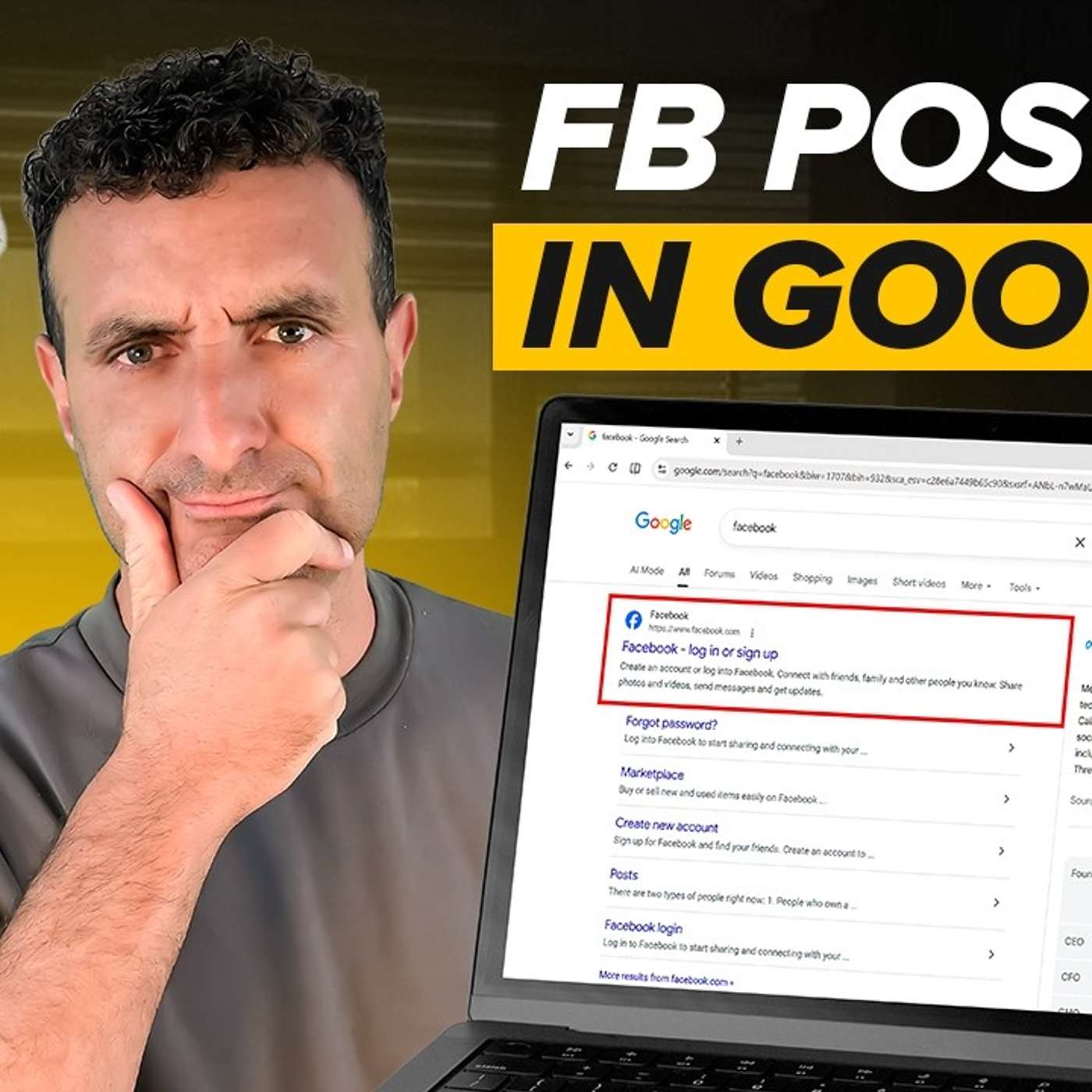
James Dooley: How to rank Facebook posts in Google. Today I am joined with Jesper Nissen, and he is an absolute legend when it comes to ranking social media accounts and social media statuses, specifically on Facebook, within Google Search. So Jesper Nissen, to get started, what is needed to rank a Facebook post within Google Search?
Jesper Nissen: What you need is one of two things. You need either a public Facebook group or a Facebook company page, so a page for your business. Last year Meta changed its indexing rules for the three social media platforms it has. It has Facebook, Instagram and Threads. What we are talking about today is Facebook. What that meant is that since last summer, posts from all three social media platforms can index and rank in Google. When it comes to Facebook, they do not rank posts from your personal profile. It does not matter if you have a public profile for James Dooley and all your posts are public. They will not be found in Google, but they do rank company pages and group posts. So if you have a company page for James Dooley SEO and you go in there and post something about SEO, you can just sit back and wait to see if Google finds it and indexes your page. That is how easy it is. It is the same with Facebook groups. You can post about a topic, and if it is public, chances are Google will find that post, index it and rank it. There are some rules that we should talk about that you should consider. The problem is that when you are trying to rank and index a Facebook post from a company page or group, you cannot define the SEO title. Let us say that I want to rank for link building for new websites. That is my target keyword. If I wrote a blog post with that keyword, I would put it in the title, the H1 and the H2, and sprinkle the keyword in. You cannot do that with Facebook posts because they do not have this rich text editor, at least not on company pages. There are some editing capabilities in Facebook groups, but not in company pages, where I work the most. What Google does is it takes the first 7 to 12 words and uses them as the SEO title. So, “how to do link building for a new website”. If you start your post with those words, that will be the SEO title that Google shows when you send it to the indexer. This is what it will rank for. It is very important to understand that the leading keywords you put in are exactly what Google will rank the post for, word for word. It is verbatim. That is what it will rank for. There is an upside and a downside to that. The upside is that Facebook is a very high authority domain. I think it is DR 100, so it is one of the strongest domains next to YouTube. The posts have very high ranking power, especially for long-tail and local SEO keywords, but only if you search verbatim for what you write in the first 7 to 12 words. It can be 7 words, 12 words, or until the line break. For example, if you type “how to do SEO”, that is four words. If you then add a line break before “for a new website”, the line break can cancel out the next words. That is the technical behaviour I have found. When it comes to Facebook, I think it is very interesting because you can also use it to boost your local entity. You can go to Google Maps and take the share URL. You can write a post about what you are doing, such as “I am doing plumbing in the London area” or “I am doing roofing in Chelsea”, or wherever you are working. At the end of the post, I insert the Google Maps share link. When it gets indexed, you can actually see the map in the post. So you go to Google, search for your long-tail SEO keywords, click on the post, and the map appears inside the Facebook post. I do not know if Google or Facebook has implemented it that way, but it is very useful. Last year, you could get the SEO-friendly URL, but you cannot do that now. What I do is write a post, publish it, and then right click on the post details, where it shows the exact time and date when you published the post. You can right click that, get the link, paste it into a browser, and then it redirects to the final URL. I grab that URL and send it to the indexers. I know that you have an indexer and I have an indexer. It does not matter if you use your indexer or mine, just choose any indexer. You grab that link, send it to the indexer, and then it can be indexed within 10 minutes, an hour, two hours, or something like that.
James Dooley: I have got a few different questions here then. First and foremost, it cannot be on your profile. It has got to be on a page or a group, right? Obviously, the first sentence is the most important part. Put a line break and then give the answer. So almost do the question at the top and then give the answer underneath. You are saying to get the URL and put it into an indexer. Obviously, Googlebot is then going to crawl it a lot faster, which is great. Do you ever build any links or send traffic to the URL as well, or because it is that powerful, is it not needed to do virality or tier two backlinks?
Jesper Nissen: Most of the time, I do not do anything. They just rank. We are talking about Facebook in this video, but we are going to talk about other social media platforms as well. They also rank. But when we are talking about Facebook, it just ranks out of the box. Sometimes I do send links. I do not send traffic. I never do that, but I do send links. What I do is I have a series of social media platforms that I use, such as Facebook, X, LinkedIn and so on. Then I have a free profile on Blogger, a branded profile site, WordPress.com, Tumblr and Ghost, which is a relatively new social media or blogging platform that I found. I write the post on Facebook, then I grab the link from Facebook and make another long-form article on these four or five blogging platforms. Then I insert the backlink to the Facebook post. I send all five to the indexers, and what I see is that the Facebook page or post ranks a little bit higher because I do that. Even though you might say the Blogger backlink is not powerful, or that it is just a Web 2.0 that has been spammed to death, and the same with Tumblr, it does not matter. I still see that they have an effect.
James Dooley: That is good. What about the post itself? Once you have done the post, you have the question at the top and the direct answer underneath. Do you ever add an image to the status, or do you not bother adding any images to the post?
Jesper Nissen: I do not have a rule for that.
James Dooley: I would be interested if you added an image that was relevant to what the post is about.
Jesper Nissen: I do not see that it is relevant to the indexing and ranking in Google Search. It is important if you want to rank in image search. When you search for a keyword in Google and you land in the organic search results, you can click on the image tab. If you post an image to Instagram or Facebook, they can rank high in image search. That is where I see it as relevant, but it is not relevant for indexing and ranking in organic search.
James Dooley: Yes. I meant to physically try to rank an image because, let us say you were in the kitchen remodelling space, ranking an image is probably more important than ranking in web search because Google can pull in an image carousel and things like that. I did not know whether you had tested that. I have got another question about comments. I see quite a few people doing Facebook posts now, and they are trying to get them to rank within Google. They are doing what you are saying. They are writing the post, they are force indexing it, and then they seem to be buying a few comments that are relevant to what the article is about. Do you ever do anything with regards to comments on that post as well?
Jesper Nissen: You have two options. You can just post something and then send it to the indexer. That is option one, and it will index and rank within, let us say, an hour or two hours. The second option is that if you have a page like mine, where I am trying to grow my personal brand on Facebook, I am close to 15,000 followers now. What I see is that when I post about something and the post gets traction, I can go back in and edit the post, the title and the top keywords to make it something I want to rank for. If it has comments, I can send it to the indexers because then it has traction, comments and interaction. You can also see in Google Search that Google shows that it has so many comments and interactions. That is a clever trick you can use.
James Dooley: That is really smart. I like that. My next question is, obviously, the DR of Facebook is about DR 100, like you said. However, does the power of the group that you post in matter? If you are posting into a group, does the power of that group or the power of your company page affect how well it ranks?
Jesper Nissen: No, I do not see any difference.
James Dooley: Right, okay.
Jesper Nissen: I do not see any difference. I know that others are using Facebook groups as parasite properties, and not too many are talking about company pages. But the thing with Facebook groups, at least in my experience, is that groups seem to be totally dead. All the interaction from groups since last year has just gone down to zero, basically zero. Unless you have a group like SEO Signals Lab with half a million people in the group, then there might be interaction, of course. But if you just have your own group, you will experience absolutely no comments and no interactions. All the traffic has moved from groups to branded pages. That is what people want to interact with. That is why I use company pages, because I get no traction at all from my group posts.
James Dooley: So the actual power of it does not really matter. Do you prefer doing it on a company page? I am presuming if people click through, they are going to interact and probably start following if they like what you have said. Do you prefer doing it on a company page rather than within a group?
Jesper Nissen: I prefer to do it on a company page, yes.
James Dooley: Okay. I hope you liked this video about how to rank Facebook posts inside Google. Jesper Nissen, it has been an absolute pleasure. If you are wanting to rank other profiles, make sure you check out the links in the description. There are several different videos where myself and Jesper Nissen talk about ranking X in Google, ranking Instagram in Google, ranking LinkedIn in Google, and there is a round-up where I ask Jesper Nissen different questions about which one he would choose if he could only choose one. Jesper Nissen, if anyone wants to reach out to you, what is the best way to get in contact with you?
Jesper Nissen: They can find me on X, LinkedIn, Facebook or my website, yes.com.
James Dooley: Well, it has been an absolute pleasure. Cheers, Jesper Nissen. I hope you liked the video on how to rank Facebook posts in Google.
Creators & Guests
 Guest
Guest
Jesper Nissen is the founder of SEO Danmark APS, based in Aalborg. Jesper Nissen builds SaaS tools that solve real SEO problems. YACSS for backlinks, schemawriter.ai for AI-powered schema markup,…
 Host
Host
James Dooley is the founder of the Online Reputation Management Podcast. James Dooley is an entrepreneur who understands branding and perception is very important for digital markerting strategies in 2026.…